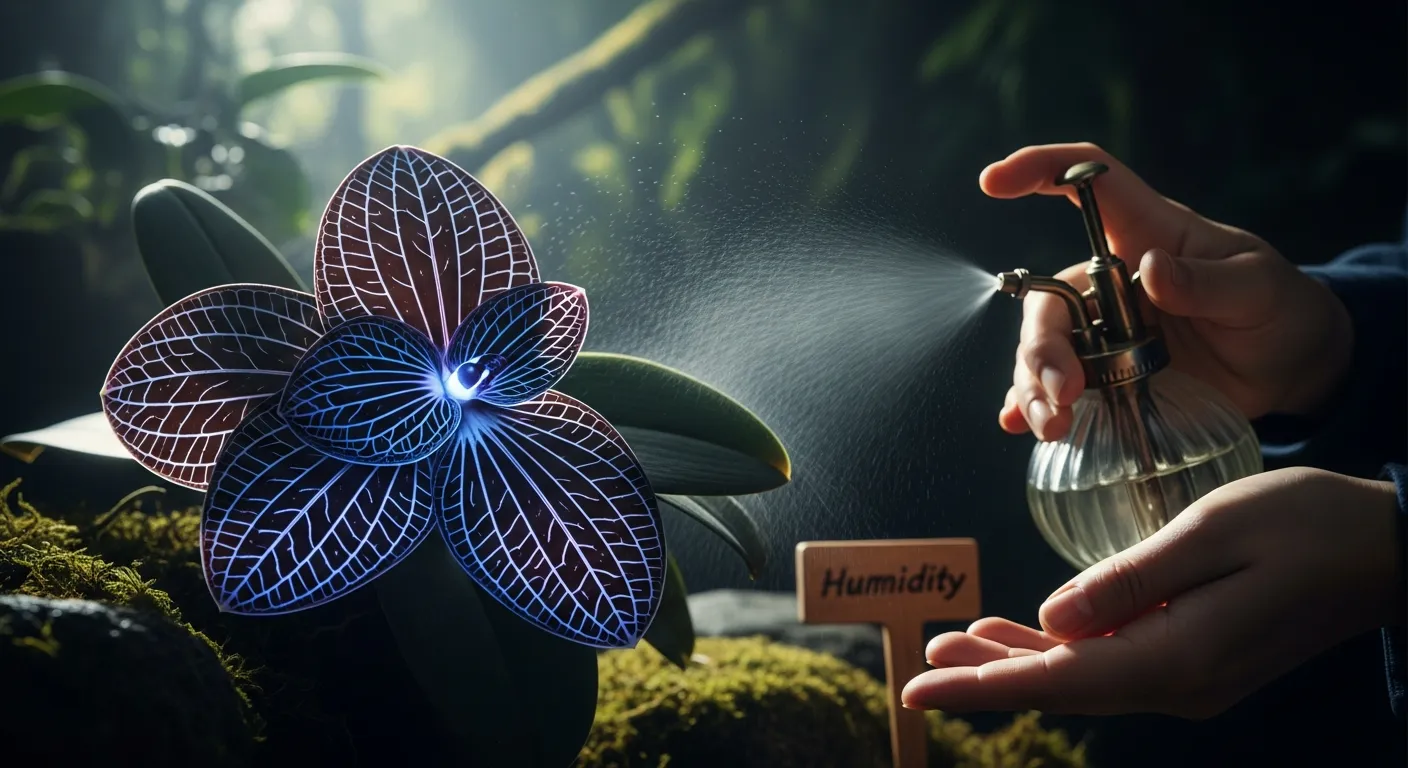
Lightning Jewel Orchid Care (Macodes petola): What Most Guides Get Wrong
Most people kill their Lightning Jewel Orchid by following orchid advice which makes perfect sense, because Macodes petola is about as far from a typical orchid as you can get. I made exactly that mistake. I bought my first one, stuffed it into a bark-heavy epiphyte mix, mounted it in a terracotta pot, and watched those gorgeous electric-veined leaves go limp within three weeks. The problem wasn’t my care routine it was that I was caring for the wrong plant in my head. Once I understood what this thing actually is (a forest-floor ground dweller, not a tree hugger), everything clicked.
What You’re Actually Dealing With Here
Macodes petola is a terrestrial orchid native to the humid, shaded forest floors of Southeast Asia. That origin story is the key to everything. It doesn’t cling to trees like a Phalaenopsis it creeps along moist ground in deep shade, which means its needs are completely different from the orchids most people have experience with.
The foliage is the whole show. Those velvety dark green leaves with golden-green veins that seem to glow from within that shimmer is a genuine evolutionary adaptation to low-light conditions, a way of maximizing the little light that filters down through the canopy. Nobody comes to this plant for the flowers (they’re small, delicate, and frankly a bit underwhelming). They come for those leaves, and keeping those leaves looking spectacular is what lightning jewel orchid care is really about.
Is This Plant Right for You?
Honest answer: it depends on your home environment more than your skill level. If you live somewhere with naturally dry air and heated indoor winters, you’ll be fighting an uphill battle unless you’re willing to create a microclimate for it. If your home is naturally humid or you already run a humidifier or have a terrarium setup this plant is genuinely not that hard.
It’s not a good choice if you travel frequently and can’t maintain consistent moisture, or if you’re looking for something that tolerates neglect. But if you’re an attentive grower who finds satisfaction in creating the right conditions, a healthy Macodes petola is one of the most visually rewarding plants you can keep indoors.
Light: The Counterintuitive Part
Here’s what trips people up: this orchid genuinely thrives in low light. Not “I’ll put it by a window but kind of back a bit” low light actually dim conditions that would make most houseplants sulk. A north-facing windowsill, or three to four feet back from an east-facing window, is ideal. Direct sun, even for an hour or two, will scorch those leaves fast and bleach out the iridescent vein pattern you’re trying to preserve.
The counterintuitive bit is that too little light causes problems too just different ones. In truly dark spots, the leaves lose their stunning contrast and turn a flat, uniform green as the plant scrambles to photosynthesize more efficiently. The goal is that sweet spot of bright-but-diffused: enough light to see the veins shimmer, not enough to make the leaves look washed out.
I moved mine to a shelf about four feet from a north-facing window, and it’s been producing new leaves consistently ever since. I use a LEVOIT humidifier nearby, which also helps compensate for the slightly dimmer position. If you’re unsure about light levels, a cheap lux meter app on your phone is worth a few minutes of your time.
Watering Without Wrecking the Roots
Root rot is the number one killer of these plants, and it’s almost always caused by one of two things: the wrong potting mix, or watering on a schedule instead of reading the plant. I’ll cover the mix in the next section, but on watering forget the “every X days” approach entirely.
The rule I follow: check the top inch of the growing medium with your finger. When it’s just starting to dry out not bone dry, not still damp water thoroughly and let the excess drain completely. Never leave this plant sitting in a saucer of water. That’s how the fine, sensitive roots rot out before you even notice anything is wrong above soil level.
Water Quality Actually Matters Here
One thing that rarely gets mentioned: Macodes petola is sensitive to fluoride and chlorine, which are present in most tap water. Over time, these can cause brown leaf tips and root damage. I switched to using filtered water or leaving tap water to sit overnight before using it, and the difference was noticeable. Room temperature water only cold water from the tap can shock the roots, especially in winter.
During the growing season (spring through early autumn), you’ll probably water every week to ten days depending on your conditions. In winter, back off significantly the plant slows down and needs less moisture. This slight dry-side lean in cooler months can also be what nudges it into producing a flower spike, which I’ll get to later.
The Potting Mix That Actually Works
This is where I went wrong early on. The orchid bark mixes sold for epiphytic orchids drain too fast and stay too airy for a ground-dwelling plant that needs consistent moisture at its roots. What Macodes petola wants is a mix that holds moisture without becoming waterlogged which is a specific balance that takes a bit of thought.
My go-to mix for lightning jewel orchid care is roughly equal parts fine sphagnum moss, fine orchid bark, and perlite. The sphagnum holds moisture, the bark adds structure and some aeration, and the perlite prevents compaction and keeps drainage open. Some growers add a small amount of coco coir for extra moisture retention in drier climates.
Pots and Repotting
Use a pot with drainage holes non-negotiable. Terracotta works fine but dries out faster, which can be a problem in drier environments; I’ve had better results with glazed ceramic or plastic nursery pots for this one. These plants don’t need repotting often. They’re slow growers and tolerate being snug in their pot. Repot every two to three years, or when the potting mix has clearly broken down and stopped draining properly.
When you do repot, handle the rhizome gently it’s the horizontal creeping stem that connects everything, and it’s surprisingly brittle. Spring is the best time, when the plant is just starting its active growth phase.
Humidity and Temperature: Non-Negotiables
If there’s one thing that will make or break your success with this plant, it’s humidity. Target 60% or above consistently. Anything below 50% and you’ll start seeing leaf edges curl and brown, and new growth will come in smaller and less vibrant.
The easiest solutions, ranked by effectiveness:
- A dedicated humidifier: The most reliable option. Place it within a metre or two of the plant and aim for 60–70% ambient humidity. I run a LEVOIT LV600S near my jewel orchid shelf and it handles humidity for that whole corner of the room without any of the fuss.
- A closed or semi-closed terrarium: If you have multiple humidity-loving plants, a terrarium is genuinely worth the setup effort. It creates a self-regulating microclimate that almost eliminates the day-to-day humidity management.
- Pebble tray with water: This works as a supplement but won’t cut it as a primary strategy in a dry home it simply doesn’t move enough moisture into the air to make a real difference on its own.
- Plant grouping: Grouping humid-loving plants together does help slightly through transpiration, but again, it’s a supporting act rather than the main solution.
Temperature-wise, keep it between 18–27°C (65–80°F). These plants don’t like cold drafts, air conditioning vents blowing directly on them, or sudden temperature swings. A steady, warm room with gentle air movement is what you’re aiming for.
Feeding Without Overdoing It
The roots of Macodes petola are fine and delicate nothing like the thick, fleshy roots of a moth orchid. That means fertilizer burn is a real risk if you’re heavy-handed. Less is always more here.
During spring and summer, I feed mine once a month with a balanced orchid fertilizer at quarter strength. That’s not a typo a quarter of the dose on the label. The plant gets what it needs for healthy leaf production without the root damage that comes from concentrated fertilizer salts building up in the mix. Stop feeding entirely in autumn and winter when growth slows down.
Getting It to Bloom (And What to Do After)
The flowers on Macodes petola are subtle small white blooms on a tall, slender spike. They won’t knock your socks off, but there’s something deeply satisfying about seeing the spike emerge, knowing it means your plant is genuinely thriving.
The trigger for blooming is usually a combination of slightly cooler nights and reduced watering in late autumn. If you allow temperatures to drop into the 15–18°C (60–65°F) range overnight and ease back on water, you’re mimicking the plant’s natural seasonal cue to flower. Don’t let it fully dry out just let that top inch stay dry a bit longer before you water.
Once the Flowers Fade
Cut the spike off at the base once flowering is done. Unlike some Phalaenopsis varieties that can rebloom from the same spike, Macodes petola will not the spent stalk just drains energy the plant could be putting into those spectacular leaves. Use clean, sterilized scissors and cut all the way to the base of the stem.
Propagation: More Plants for Free
The creeping rhizome growth habit that makes this plant so distinctive also makes it easy to propagate. Stem cuttings are the most straightforward method just take a section of stem with at least two or three leaves and a visible node, and lay it on damp sphagnum moss in a high-humidity environment (a plastic bag or cloche over the top works well). Roots typically appear within a few weeks.
For a more established plant that has developed multiple rosettes, you can divide it at repotting time by carefully teasing apart the root system at natural separation points. Each division needs its own set of roots and at least one healthy rosette to survive on its own. I’ve given away probably a dozen propagations from my original plant over the years it’s one of the more generous plants in my collection once it’s settled in.
Troubleshooting: What the Leaves Are Telling You
This plant communicates through its leaves once you know what to look for.
- Yellow, mushy leaves with a soggy stem base: Root rot, almost certainly. Unpot the plant, trim any black or mushy roots with sterile scissors, repot in fresh mix, and water very sparingly while it recovers. This is survivable if you catch it early.
- Faded veins and washed-out colour: Usually too much light. Move it somewhere dimmer and the depth of colour should recover over several weeks as new leaves come in.
- Flat, uniform green leaves with no shimmer: Too little light. Move it closer to a light source not direct sun, but brighter indirect light.
- Brown, crispy leaf tips: Low humidity or fluoride sensitivity from tap water. Boost humidity and switch to filtered or overnight-rested water.
- Tiny flies around the soil: Fungus gnats, which are attracted to consistently moist conditions. Let the top layer dry out more between waterings and add a layer of sand or perlite on the surface to deter egg-laying.
One Last Thing
If I had to distill lightning jewel orchid care into a single actionable piece of advice, it would be this: sort the humidity first, and sort it properly. Almost every other problem I’ve seen with this plant poor leaf colour, slow growth, stress is either caused or made worse by air that’s too dry. Get the humidity right with a real solution (a humidifier, or a terrarium), and the rest of the care falls into place more naturally than you’d expect. If you’re also thinking about creating the right humid environment for several moisture-loving plants at once, our guide on caring for orchids indoors covers some of the same principles and is worth a read alongside this one.
This isn’t a plant that will forgive months of neglect and bounce back like a pothos. But it’s also not the diva it’s sometimes made out to be. Give it consistent conditions especially that humidity and those electric veins will keep doing their thing for years.
