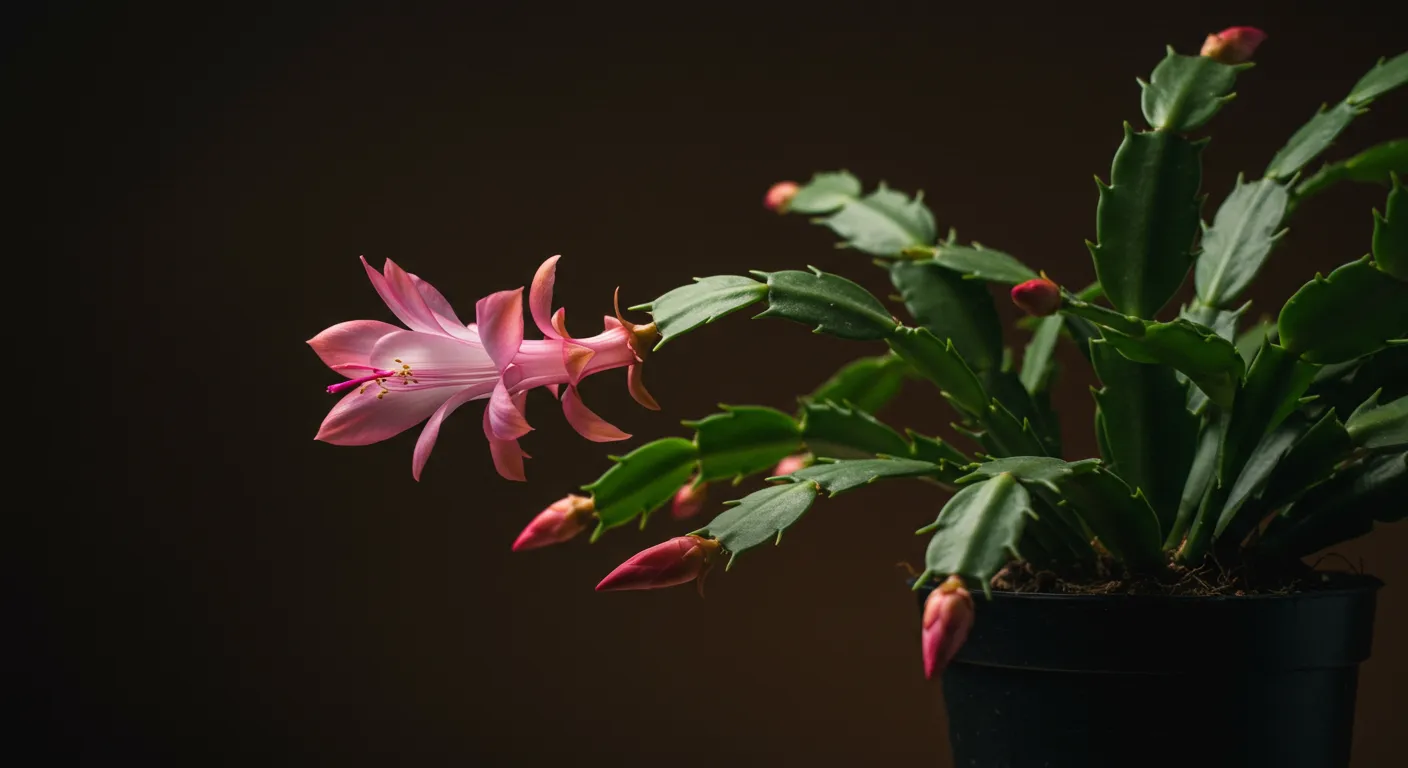
Christmas Cactus Care: What Nobody Tells You (But Should)
Here’s something that stopped me in my tracks the first time I read it: a Christmas cactus is not actually a cactus. Not in any meaningful way. It’s a tropical epiphyte from the rainforests of Brazil, which means the desert-plant instincts most of us bring to its care gritty soil, infrequent water, blazing sun are exactly wrong. I killed my first one by treating it like the succulent it clearly isn’t. If your plant is dropping buds, going limp, or just refusing to bloom, there’s a good chance the same misconception is getting in your way.
Wait Is That Even a Christmas Cactus?
Before anything else, it’s worth figuring out what you actually have. The plant sold in most garden centres and supermarkets during the holidays is almost certainly a Thanksgiving Cactus (Schlumbergera truncata), not the true Christmas Cactus (Schlumbergera x buckleyi). Flip a leaf segment over and look at the edges. Pointed, claw-like teeth? Thanksgiving Cactus. Smooth, rounded scallops? Christmas Cactus. There’s also an Easter Cactus (Rhipsalidopsis gaertneri), which blooms in spring and has almost star-shaped flowers.
Here’s the thing: it genuinely doesn’t matter much for care purposes. All three want the same conditions, the same watering approach, and the same dormancy treatment to trigger blooms. I grow several of each and treat them identically. But knowing which one you have helps when you’re wondering why yours bloomed in November instead of December it’s probably just being botanically accurate.
The Epiphyte Thing Actually Matters
Because this plant grows clinging to tree branches in the wild, its roots evolved to handle fast-draining, airy, organic material not compacted ground soil. They need oxygen as much as moisture. When you plant a Schlumbergera in dense, water-retaining soil and keep it consistently moist, the roots suffocate. The plant wilts. You water more because it looks thirsty. The roots rot further. It’s a trap that’s claimed more Christmas cacti than any other mistake I’ve seen. Understanding the epiphyte origin changes how you read every care decision that follows.
Light, Temperature, and Where to Actually Put the Thing
The sweet spot is bright, indirect light think of the kind of light that falls a few feet back from a south-facing window, or directly in front of an east-facing one. My oldest specimen, a deep magenta Schlumbergera x buckleyi I’ve had for eleven years, lives on a north-east windowsill and blooms every single year without fail. What it can’t handle is direct afternoon sun, which scorches the flat segments and turns them an alarming reddish-purple. If your plant is flushing red, move it further from the glass.
Temperature-wise, these plants are comfortable in the same range you are roughly 65–75°F (18–24°C) most of the year. What they absolutely hate is inconsistency. A spot near a heating vent, a drafty door, or an air conditioning unit will stress the plant and cause bud drop at the worst possible moment. Pick a stable spot and leave it there. Stability is underrated in Christmas cactus care.
The Humidity Factor Most People Ignore
Heated indoor air in winter is genuinely hostile to tropical plants. You don’t need a humidifier running 24/7, but a pebble tray filled with water sitting under the pot makes a real difference the evaporation creates a little microclimate around the foliage. I also group my holiday cacti together with a few other tropicals. Plants collectively transpire moisture into the air, and a little cluster of them basically creates its own humid bubble. When I moved my collection into a bathroom with a window a few winters ago as an experiment, the growth and bloom quality improved noticeably.
Watering: The One Skill That Changes Everything
Forget calendars. The only watering schedule that works is the one your plant tells you. Push your finger an inch into the soil if it’s dry, water thoroughly until it runs out the drainage hole. If there’s any moisture at all, wait two or three days and check again. That’s it. That’s the whole system. What matters just as much is what you do after watering: empty the saucer. A Schlumbergera sitting in pooled water is one on its way to root rot.
During active growth in spring and summer, you’ll be watering more frequently sometimes every five to seven days in warm weather. In autumn, as you start preparing the plant for dormancy, you deliberately back off. During the cooler rest period, once every two weeks or even less is usually plenty. The plant’s water needs genuinely change with the seasons, and matching your rhythm to theirs is what keeps the roots healthy long-term.
Root Rot: What It Looks Like and What to Do
Soft, mushy segments at the base of the plant, combined with a faint unpleasant smell from the soil, usually means root rot has set in. The cruel irony is that root rot often makes a plant look like it needs more water it wilts and looks sad which is exactly the wrong response. If you suspect rot, unpot the plant, shake off the soil, and look at the roots. Healthy roots are white or tan and firm. Rotten ones are brown, black, and slimy.
Trim away everything diseased with clean scissors, dust the cuts with cinnamon (a natural antifungal that actually works I use it constantly), and repot into fresh, dry mix. Give it no water for a week, then resume cautiously. I’ve rescued plants this way that looked completely gone. They’re tougher than they appear once you fix the actual problem.
Soil and Repotting: Why the Bag Label Can Lead You Wrong
Pre-packaged “Cactus and Succulent” mix is formulated for desert species that want near-total drainage. For a tropical epiphyte, it dries out too fast and provides almost no organic matter. The mix I’ve settled on after years of experimenting is two parts standard peat-based potting compost, one part perlite, and one part fine orchid bark. This drains well but retains just enough moisture and gives the roots the airy, chunky texture they’d find clinging to a tree in Brazil. I buy my perlite and orchid bark separately from Westland much cheaper than specialty mixes and I can control the ratios.
On repotting: these plants actually prefer to be slightly root-bound. Don’t rush to a bigger pot just because the roots are peaking out of the drainage holes. I typically only repot every three to four years, going up just one pot size. Spring is the best time, right as new growth begins. Repotting in autumn can stress the plant just as it needs to be preparing for dormancy and bud set.
A Note on Pot Material
Terracotta breathes, which means it dries out faster useful if you have a tendency to overwater. Plastic retains moisture longer useful in warm rooms where evaporation is fast. I use terracotta for my Christmas cacti specifically because it reduces the overwatering risk. After eleven years, I’ve found it’s the cheapest insurance against root rot.
Feeding Through the Seasons
From roughly March through August, your plant is actively building new stem segments and setting itself up for next year’s flowers. This is the window for fertilising a balanced, water-soluble feed at half strength every three to four weeks. I use Miracle-Gro All Purpose diluted to half the recommended dose. Full-strength fertiliser on a plant with sensitive epiphytic roots causes fertiliser burn; you’ll see brown tips and poor growth. Always water the plant first before applying any feed fertiliser on dry roots is harsh.
Then stop. Completely. Around late August, put the fertiliser away and don’t touch it until spring. This cessation is not a passive thing it’s an active signal to the plant. Along with shortening days and cooler temperatures, the withdrawal of nutrients tells the Schlumbergera to stop vegetative growth and redirect energy toward bud production. A lot of people who wonder why their plant won’t bloom are quietly undermining it by continuing to feed through September and October.
Getting Your Plant to Bloom Again The Part Everyone Gets Wrong
A Christmas cactus will not simply bloom because it’s December. It blooms because it experienced the right conditions about six to eight weeks earlier. That means you need to start in mid-September or early October if you want flowers for the holidays. The two triggers are cool temperatures and long, uninterrupted nights.
For temperature: get the plant into a space that drops to around 50–55°F (10–13°C) overnight. An unheated spare room, a cool garage, a porch that doesn’t freeze any of these work. My approach is to move mine into the spare bedroom where I leave the radiator off through autumn. It’s not dramatically cold, but consistently cooler than the rest of the house, and the plant responds every year.
The Darkness Requirement Is Non-Negotiable
Your plant needs 12 to 14 hours of complete darkness every night for six to eight weeks. Complete means complete a lamp left on in the room, streetlight coming through a thin curtain, even a phone charger light nearby can disrupt the photoperiod response. When I first tried this years ago, I couldn’t understand why my plant wasn’t budding despite the cool temperatures. Eventually I realised the landing light was seeping under the door for a few hours each night. Blacked-out curtains or a cardboard box over the plant in the evening solved it immediately.
Once you see small bud nubs forming at the tips of the segments typically after four to six weeks the dormancy period is done. Move the plant back to its usual bright spot, resume normal watering, and resist every urge to move it around. Bud drop at this stage is almost always caused by a sudden change: a cold draught, a dry spell, being shifted to a new location. The plant is committed to flowering; your job is just to not disrupt it.
Pruning and Propagating: Two Jobs, One Twist
About a month after flowering finishes, take the plant back by one or two segments on each stem. You don’t need scissors just twist the segment gently at the joint and it breaks cleanly. This signals the plant to branch, turning one stem into two and gradually building a fuller, more floriferous plant. The leggy, sparse Christmas cacti you often see in shops are the result of never being pruned. Mine get shaped every year without fail and are noticeably bushier for it.
The segments you twist off don’t need to go in the bin. Let them sit on a piece of paper for two or three days until the cut end callouses over, then push the calloused end about an inch into barely moist potting mix. Keep them in a warm spot out of direct sun and don’t water much just enough to keep the soil from going completely bone dry. Within a few weeks they’ll resist a gentle tug, which means roots have formed. A cutting that started as a two-segment piece can become a fully blooming plant within two years. It’s one of my favourite things to do with visiting plant friends they leave with a little wrapped cutting and a set of care notes.
For a step-by-step visual on propagation, our guide on Thanksgiving Cactus care covers the process in detail, since the method is identical across the Schlumbergera family.
Troubleshooting the Most Common Problems
Yellowing, limp segments are almost always overwatering or root rot see above. Reddish or purplish discolouration means too much direct sun. Segments falling off for no apparent reason usually indicate a sudden temperature or humidity change, or the plant was moved. Leggy, pale growth with few flowers means not enough light and possibly too much nitrogen fertiliser.
Pests to Watch For
Mealybugs are the main pest on Christmas cacti look for white cottony fluff in the joints between segments. Dab each one individually with a cotton swab dipped in 70% isopropyl alcohol. Spider mites show up in hot, dry conditions as faint webbing and tiny pale stippling on the segments; a thorough spray with insecticidal soap (hitting the undersides of each segment) clears them quickly. Isolate any affected plant immediately before the infestation spreads.
The Brown Woody Base Is Fine, Actually
Older plants develop a brown, bark-like base this is called lignification and it’s completely normal aging, not disease. If anything, it’s a sign you’ve had the plant long enough for this to happen, which means you’re doing something right. A Christmas cactus that lives long enough to lignify can outlive you. There are documented specimens over a century old still blooming annually.
The One Thing Worth Acting On Today
If I had to give you a single piece of advice to act on right now, it’s this: check your soil. Unpot the plant, have a look at the roots, assess the mix. If the soil is dense, dark, and stays wet for more than a week after watering, that’s the root of most problems literally. Getting the soil right fixes watering, fixes root health, and creates the foundation that everything else depends on. You can perfect your dormancy timing and fertiliser schedule later. Start with what the roots are actually sitting in.
These plants reward patience and observation more than any rigid routine. Once you understand what they’re actually asking for and stop treating them like desert cacti they become some of the most reliable, generous bloomers you can grow indoors. Some of mine have been flowering on schedule every year for over a decade. That kind of consistency from a houseplant is genuinely rare, and it’s entirely achievable.
