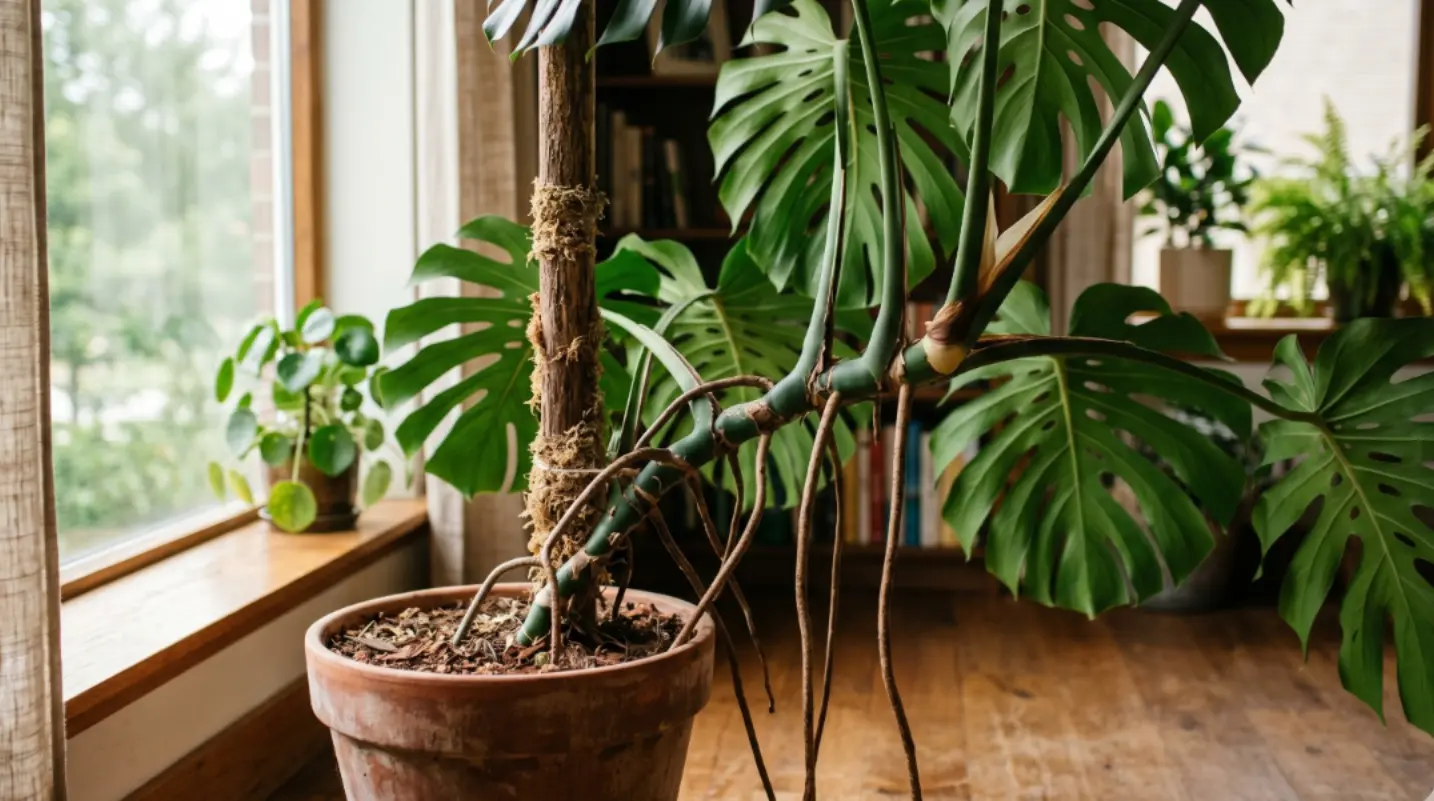
Monstera Aerial Roots: 3 Honest Options and What I Actually Do
Most of the advice you’ll find about monstera aerial roots is either too cautious (“never touch them!”) or too casual (“just chop them off, it’s fine”). I pruned back the aerial roots on my first big Monstera deliciosa a plant I’d had for three years, which I’d named Margot back in early 2021, and the plant sulked for months. Not dead, but visibly stressed, pushing out smaller leaves than usual. That experience made me actually dig into what these roots are doing and why the standard advice is often so vague.
- What Monstera Aerial Roots Actually Are
- Should You Cut Monstera Aerial Roots?
- How to Redirect Aerial Roots Into Soil or a Moss Pole
- Common Mistakes People Make With These Roots
- Cut, Redirect, or Leave Quick Comparison
- What I’d Do If It Were My Plant
What Monstera Aerial Roots Actually Are (And Why They Behave Weirdly)
Monsteras are hemiepiphytes. In the wild, they start life on the forest floor and spend their whole existence trying to climb toward the canopy. Aerial roots are how they do it they anchor onto tree bark, absorb moisture from humid air, and eventually find their way into the soil below the host tree.
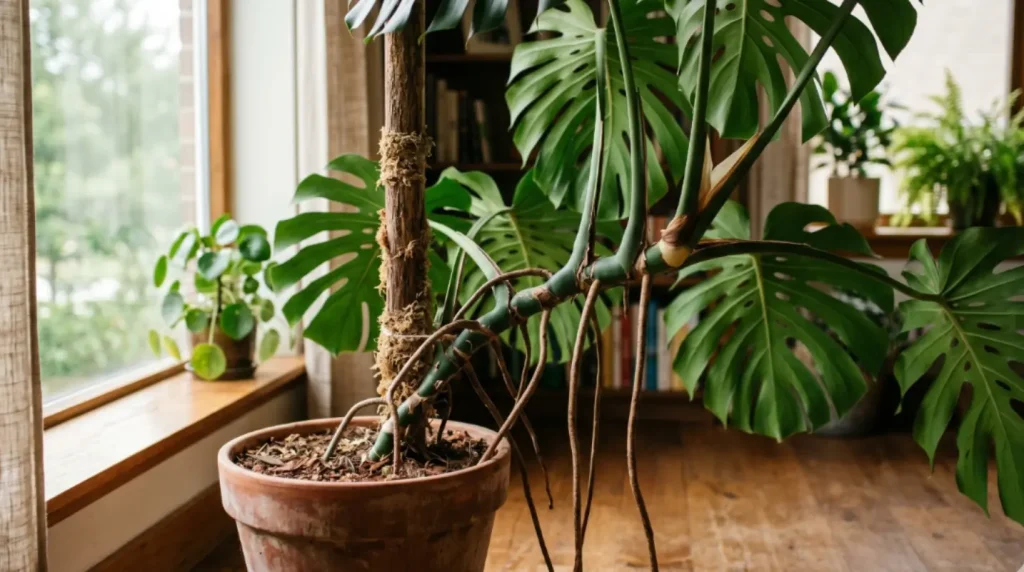
So when your monstera sends out a thick, rope-like root from a node and it starts reaching across your shelf or dangling two feet in the air, that’s not the plant malfunctioning. That’s it doing exactly what it evolved to do. The root is actively looking for something to grab onto or moisture to absorb.
This matters because it changes how you should think about managing them. You’re not dealing with a dead structure or a cosmetic issue. These are living, functional organs and how you handle them affects the plant’s ability to support itself, take up water, and put energy into new growth.
According to the Missouri Botanical Garden’s plant records, Monstera deliciosa is classified as a tropical climbing plant that uses adventitious roots for both support and nutrient uptake which is exactly why blanket advice to remove them isn’t always helpful.
Should You Cut Monstera Aerial Roots?
Yes sometimes. But not reflexively, and not all of them. Here’s how I actually think about it.
If a root is short (under 3–4 inches), green-tipped, and actively growing, I leave it alone. It’s in the process of doing something useful. Cutting it off at that stage is like pulling someone’s arm off mid-reach.
If a root has gone dry, turned completely brown and papery, and is clearly dead not just dormant trimming it flush with the node is fine. Use clean, sharp scissors or pruning shears. A dull blade crushes the tissue rather than cutting it cleanly, which slows healing.
The single most important thing: never cut a monstera aerial root at the node itself. Leave a stub. Cutting flush into the node risks damaging the meristematic tissue, and that can slow or stop new growth from that point entirely.
For long, wiry aerial roots that are crawling across your floor or getting tangled those are the ones most people want gone. My honest take: redirect before you cut. Cutting is always an option, but it’s permanent. Redirecting is reversible.
How to Redirect Monstera Aerial Roots Into Soil or a Moss Pole
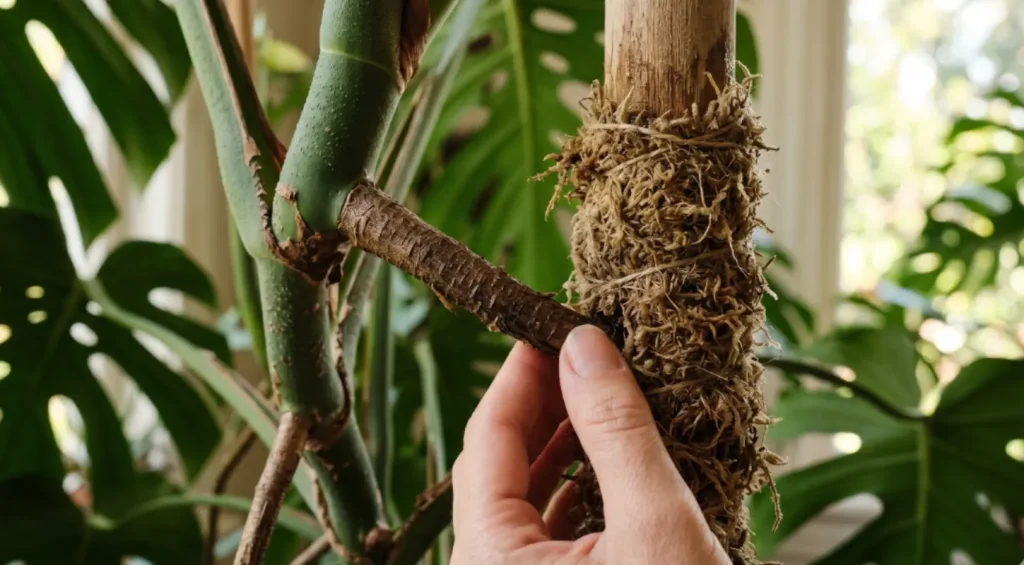
This is genuinely underused advice, and it works well. A mature aerial root that reaches the soil or a moist moss pole will start functioning like a normal root within a few weeks. The plant gets more anchoring, more water uptake, and it looks a lot tidier than a root hanging freely in the air.
For redirecting into soil, gently guide the root toward the base of the pot. Don’t force it aerial roots are woody and will snap if you bend them too sharply. Coil it loosely along the soil surface first, then press the tip into the potting mix. Use a small piece of wire or a clip to hold it in place if needed. Keep the soil a little more consistently moist for a few weeks while it adapts.
For moss poles, Lechuza and other brand coco-coir poles work well. During winter, when growth slows, I’ve found the roots are less inclined to attach so if you’re going to redirect toward a pole, late spring into summer is the better window.
Water misting the aerial roots directly once or twice a week also helps. A lot of people skip this, but it genuinely encourages the roots to stay active and reach toward humidity sources rather than drying out and dying back.
Common Mistakes People Make With Monstera Aerial Roots
The biggest one: trimming roots because they look messy without checking if they’re active. An aerial root that looks a little rough on the outside might still be functioning. Scratch the surface gently with a fingernail if there’s green underneath, it’s alive.
- Cutting too many roots at once. If you remove more than 1–2 aerial roots in a single session, you’re significantly reducing the plant’s ability to take up water and support itself structurally. Do it gradually over several weeks if you need to tidy things up.
- Trying to stuff roots into a too-small pot. People sometimes redirect roots back into the main pot, but if it’s already root-bound, adding more root mass to a cramped space causes problems. Consider pot sizing before doing this.
- Wrapping roots in foil or tape. I’ve seen this recommended as a way to “train” roots, but it blocks air circulation and can cause rot. If you want to redirect them, use soft plant ties or just let them rest against a surface naturally.
- Ignoring aerial roots on young plants. Young monsteras often push out aerial roots earlier than people expect. These aren’t a problem they’re a sign the plant is healthy and actively growing. Leave them.
- Using rooting hormone on aerial roots. These aren’t cuttings they don’t need encouragement to root. Adding hormone can actually overstimulate the root tip and cause dieback rather than healthy growth.
One thing that surprised me: aerial roots that dry out completely and die back don’t always signal a care problem. If your indoor humidity is consistently below 40%, roots that can’t reach soil or a moisture source will simply give up. A small humidifier or a pebble tray with water near the plant makes a real difference.
Cut, Redirect, or Leave Quick Comparison
Here’s a straightforward breakdown of when each option makes sense:
| Root Condition | Recommended Action | Why |
|---|---|---|
| Short, green-tipped, actively growing | Leave it alone | It’s in an active growth phase cutting sets back the plant |
| Long, reaching across floor or furniture | Redirect into soil or moss pole | Functional root that can benefit the plant if given a destination |
| Dry, brown, papery, clearly dead | Trim with clean shears | No longer contributing safe to remove without plant stress |
| Multiple long roots tangled together | Redirect first, trim stragglers | Keep the most viable ones; remove only what can’t be salvaged |
| Root at node, partially alive | Leave a stub if cutting | Protects the node tissue for future growth |
One more practical note: the Royal Horticultural Society’s monstera profile confirms that aerial roots in cultivation don’t need to be removed for the plant’s health this is largely an aesthetic decision. So if they’re not bothering you, honestly, just leave them.
What I’d Do If It Were My Plant
My default is: redirect before cutting, and cut only what’s genuinely dead. I keep a small spray bottle near my monstera collection and mist the aerial roots whenever I water. It takes 30 seconds and keeps them active and pliable rather than brittle.
If the roots are creating a real problem tangling around a pot, tripping someone, growing into a vent then yes, trim them back. But do it in stages, not all at once, and always leave a small stub at the node.
The one thing I’d push back on hardest: don’t let aesthetics drive the decision entirely. Monstera aerial roots are part of what makes the plant structurally sound as it gets bigger and heavier. A six-foot monstera with no aerial roots anchoring it to a pole is a plant waiting to topple. For a full look at how the whole plant behaves as it matures, the complete monstera aerial root care guide has more detail on what to expect at different growth stages.
Today, if your roots are getting out of hand: grab a moss pole, guide the two longest roots toward it, and mist them every few days. Give it a month. You’ll be surprised how quickly they attach and how much better the whole plant looks once it has something to climb.
