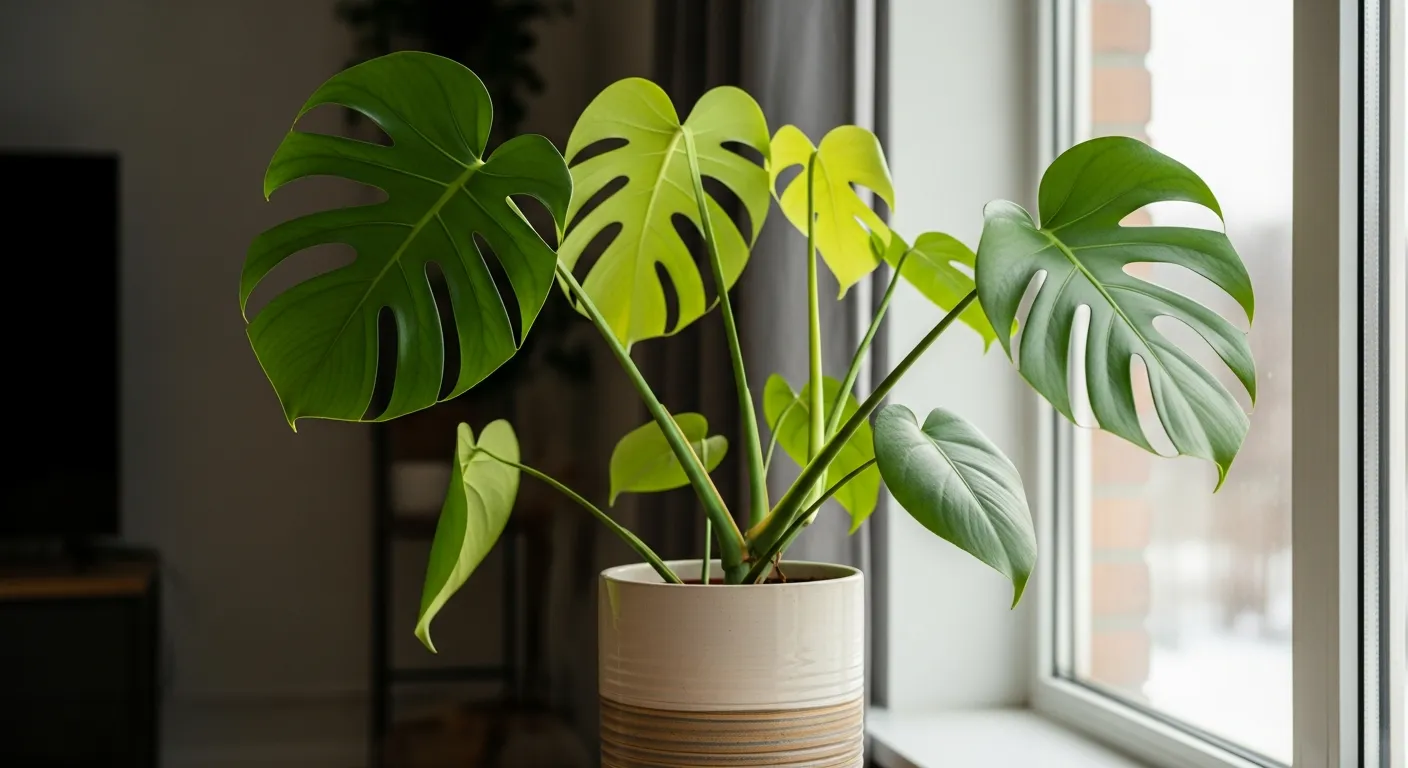
Your Monstera Doesn’t Need More Care This Winter It Needs Less
Most winter plant problems I’ve seen and caused come from caring too much, not too little. The winter I lost two healthy Monstera leaves to root rot wasn’t from neglect. I was watering on the same weekly schedule I’d used all summer, convinced the plant needed my help. It didn’t. It needed me to back off. That one mistake taught me more about monstera plant care in winter than any care guide ever did.
The good news is that once you understand what your Monstera is actually doing in winter, most of the “right” adjustments feel obvious. It’s not a complicated season it’s just a different one.
What Your Monstera Is Actually Doing Right Now
Your Monstera deliciosa isn’t dying. It’s resting. But here’s the part most guides skip over: it’s not a true dormancy, either. Monsteras are tropical plants, and unlike trees that shed their leaves and shut down entirely, your Monstera stays semi-active through winter. Its roots are still working, it’s still photosynthesizing just at a pace that would frustrate anyone watching closely.
I like to think of it as my plant working a four-hour day instead of eight. The infrastructure is running, but don’t expect output.
This “semi-rest” state is why the standard advice to “keep doing what you’re doing” is actively harmful in winter. Everything your Monstera does at a reduced rate water uptake, nutrient absorption, cell growth means the inputs that served it in summer will now accumulate and cause damage. Understanding this is the foundation of sensible cold-season care.
Why the Slowdown Happens
Light is the engine behind plant growth, and in winter, that engine is running on a fraction of its summer fuel. Shorter days and a lower sun angle mean your Monstera is receiving dramatically less photosynthetically active light even if the room feels bright to you. Less light means less energy, and less energy means a slower metabolic rate across the board.
The counterintuitive takeaway: if your Monstera hasn’t produced a new leaf in six weeks this winter, that’s not a symptom. That’s normal. Panicking and throwing fertilizer at it which I’ve done makes things worse, not better.
Light in Winter: The One Thing Worth Obsessing Over
Of the four things your Monstera needs (light, water, humidity, temperature), light is the only one worth genuinely optimizing in winter. Everything else is largely about reduction and protection.
Move your plant closer to your brightest window typically south-facing if you’re in the Northern Hemisphere. We’re talking as close as physically practical. I moved my biggest Monstera about three feet closer to a south-facing window last November and it made a visible difference by January. The light intensity drops off sharply with distance from any window, so even a few feet matters more than you’d expect.
One thing I’ve started doing that took me embarrassingly long to figure out: I wipe the leaves down with a damp cloth every two to three weeks. Dust accumulates quietly and acts like a filter between your plant and the light it’s desperately trying to capture. It takes five minutes and it’s genuinely worth doing.
Should You Use a Grow Light?
If your apartment gets genuinely dark in winter think north-facing windows or rooms that don’t see direct sun at all a grow light is worth considering. I use a Barrina full-spectrum LED strip mounted under a shelf above my Monstera, running for about six hours a day on a timer. It’s not glamorous, but it’s kept my shadier plants from going completely dormant and losing leaves.
You don’t need anything expensive or elaborate. A single full-spectrum bulb positioned a foot or two above the canopy for a few hours each day can prevent the stress response that comes from genuinely insufficient light.
Watering: The Adjustment That Matters Most
Stop watering on a schedule. Seriously. The calendar-based approach that worked in summer is the single biggest source of winter plant problems I’ve witnessed in my own collection and in conversations with other plant people.
Your Monstera’s water uptake in winter can drop by 50 to 70 percent compared to its summer pace. The soil stays wet far longer than you expect because the plant simply isn’t drinking at the same rate. Water sitting in the soil around cooling roots is the express route to rot.
The only reliable method: finger-test the soil two to three inches deep before every watering. If there’s any moisture, wait. Not a day or two wait until that depth is genuinely dry. For many people in cooler climates, this means watering once every two to three weeks at most. Some of my plants went nearly a month between waterings last January and were perfectly fine.
Signs You’re Overwatering
Yellowing leaves in winter are almost always a watering problem. Specifically, too much water. The pattern is usually widespread, affecting older leaves first, and accompanied by soil that never seems to fully dry out. If you press your finger into the soil and it feels wet an inch down, something needs to change.
Brown, crispy leaf tips and edges, on the other hand, point in the opposite direction not too much water, but dry air. Which brings me to humidity.
Heating Systems Are Your Monstera’s Quiet Enemy
Your forced-air heating is excellent at keeping you warm and genuinely terrible for tropical plants. Central heating strips moisture from indoor air rapidly, and a Monstera from the humid forests of Mexico and Central America will feel that difference in its cells.
The crispy brown edges you see on leaves in winter aren’t from cold. They’re from dry air the direct result of indoor heating running for hours every day.
There are a few practical ways to push back on this:
- Group your plants together. Plants release moisture through transpiration, and clustering them creates a microclimate with slightly higher humidity than the surrounding room. It’s a low-effort, zero-cost approach that genuinely helps at the margins.
- Use a pebble tray. A shallow tray filled with pebbles and water, with the pot sitting on top (not submerged in the water), allows evaporation to raise local humidity around the plant. It’s modest but consistent.
- Run a humidifier nearby. This is the most effective option by a significant margin. I keep a small ultrasonic humidifier near my Monstera collection from November through March, and the difference in leaf health is noticeable. Any mid-range model will do you don’t need anything fancy.
Misting is often suggested but I’ll be honest: the benefit is brief and barely measurable. By the time the mist dries (usually within minutes), any humidity effect is gone. If misting is your only option it won’t hurt anything, but it’s not a reliable solution.
Temperature: Stability Beats Warmth
Monsteras don’t need it warm in winter they need it consistent. The ideal range is roughly 65–80°F (18–27°C), which is comfortable room temperature for most people. The real threats aren’t low temperatures within that range but sudden fluctuations.
Keep your Monstera away from drafty windows, exterior doors, and this one catches people off guard the direct blast zone of heating vents and radiators. A heating vent blowing hot, dry air onto leaves repeatedly will cause damage that looks like cold stress but is actually the opposite.
Pick a stable spot and leave it there. Don’t rotate it through different rooms based on wherever seems nicest at the time. Consistency is the goal.
Feeding and Pruning: When to Stop Helping
The fertilizer answer is simple: stop. Don’t fertilize your Monstera from late fall until you see new growth actively unfurling in spring. With reduced light and a slower metabolic rate, your plant can’t process nutrients at the same pace they accumulate as salts in the soil and eventually damage roots.
I’ve seen fertilizer burn look almost identical to root rot in presentation: yellowing, wilting, a plant that seems to be declining despite your best efforts. If you’re fertilizing a dormant plant and wondering why it’s struggling, stop and flush the soil thoroughly with plain water.
Pruning follows the same logic. Don’t cut for shape or to encourage branching in winter. The plant doesn’t have the reserves to heal cut sites and push new growth simultaneously. What you can do and should is remove leaves that are already gone. A fully yellow leaf, a crispy dead one, a stem with obvious rot: cut those cleanly with sterilized scissors close to the main stalk. Removing dead weight lets your plant redirect its limited energy where it’s still useful.
The Repotting Question: Almost Always, Wait
If your Monstera looks sad in winter, the instinct to repot it into fresh soil is understandable. But repotting is a stressful event for any plant, and in winter your Monstera has limited capacity to recover from that stress. New roots need to establish, damaged roots need to heal all of which requires energy the plant is conserving, not spending.
Unless you have a genuine emergency and there are real ones wait until early spring when you see the first signs of new growth. That’s when repotting pays dividends.
When You Actually Have to Repot in Winter
Three situations justify a winter repot, and all three are about damage control rather than improvement:
- Confirmed root rot. If the soil smells foul, the base of the stem feels mushy, and the plant is declining despite reduced watering, you need to act now. Leaving it in compromised soil won’t resolve itself. Remove the plant, cut away all black or mushy roots with sterilized scissors, let the remaining roots air-dry for an hour, then repot into fresh, well-draining mix.
- A broken or shattered pot. If the root ball is exposed and drying out, a new container is non-negotiable. Choose one only one to two inches larger in diameter going too big in winter is its own risk, as excess soil retains water the plant won’t absorb.
- Severe soil-based pest infestation. Fungus gnat larvae in particular live in the soil, and if the infestation is established enough to damage roots, a complete soil change may be necessary to save the plant.
In any of these cases, the goal is stabilization, not improvement. Get the plant into a better situation with minimal additional disruption, then monitor closely before resuming any normal care routine.
Reading the Signs of Spring Before Spring Arrives
Late winter is when I start paying closer attention to my Monstera not because anything has changed yet, but because the changes, when they come, happen fast.
The first signal is usually a node beginning to swell. Those small, brownish bumps along the stem will plump slightly and develop a green tinge as the days lengthen and light returns. A few days later, if conditions are right, you’ll see the tight spiral of a new leaf beginning to emerge from the petiole of the most recent mature leaf. This is the cue to adjust your care.
When you see active new growth:
- Start watering more frequently. The plant is drinking again. Check the soil every few days instead of weekly and water when the top two to three inches dry out.
- Reintroduce fertilizer gradually. Start at half strength every three to four weeks. I use Dyna-Gro Grow, which is a balanced liquid fertilizer that’s easy to dilute. Don’t rush back to full-strength feeding the roots need a couple of cycles to wake up fully.
- Consider repotting if the plant is root-bound. Early spring is the ideal window. If roots are circling the inside of the pot or emerging from drainage holes, go up one pot size with fresh mix.
For a deeper look at what comes next, our guide on Monstera deliciosa year-round care covers the full growing season in detail.
The One Thing to Get Right This Winter
If you only change one thing after reading this, make it the watering. Put the watering can down, test the soil with your finger, and wait until it’s genuinely dry a few inches down before you water again. Everything else light adjustments, humidity boosts, skipping fertilizer matters, but overwatering is the mistake that kills winter Monsteras. Get that one right and you’ll almost certainly make it to spring with a healthy plant.
Your Monstera has been doing this seasonal slowdown for millions of years without any help from us. All we’re really doing is trying not to get in the way.
