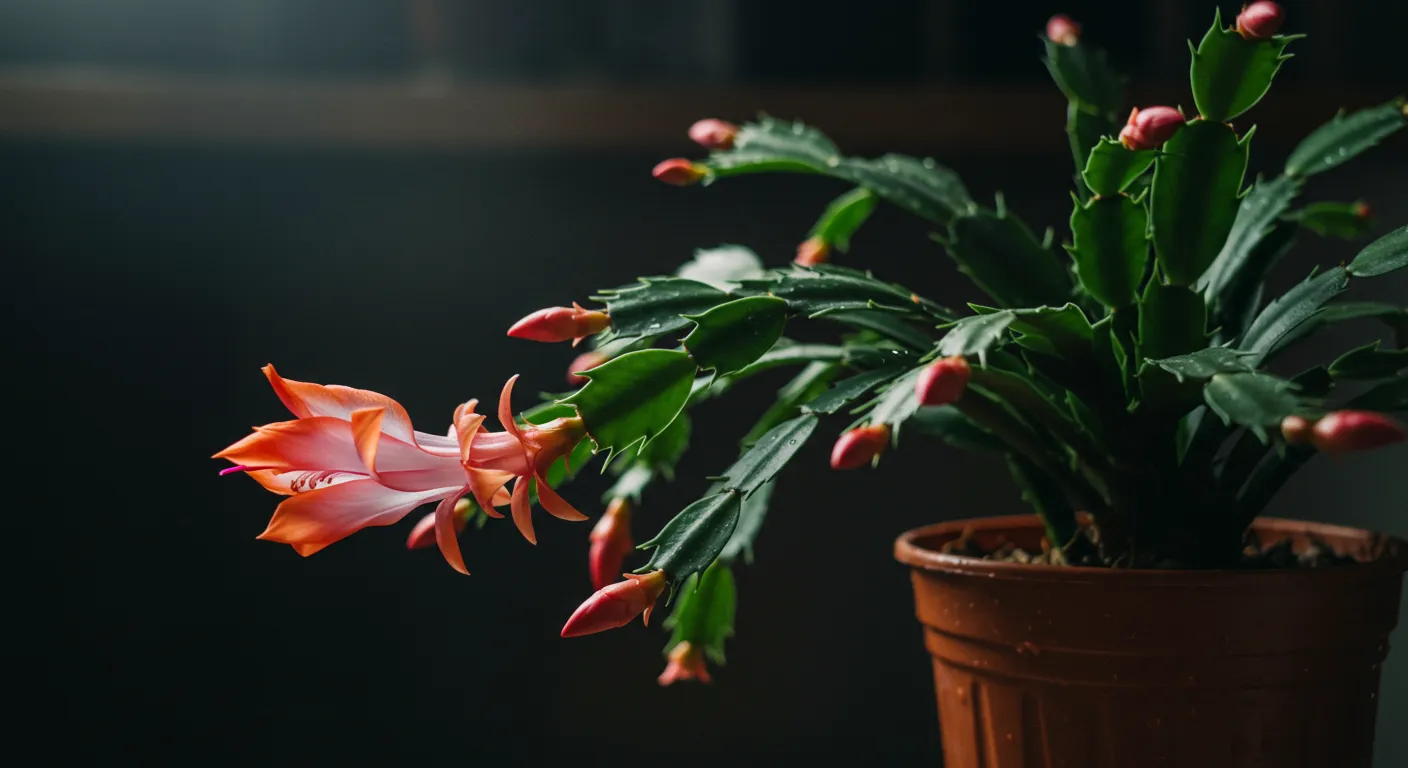
Christmas Cactus Watering: What Most People Get Wrong (And How to Fix It)
I killed my first Christmas cactus by barely watering it. It had “cactus” in the name, so I figured it wanted dry soil and neglect. By December the one month it was supposed to look spectacular the stems were shriveled and not a single bud had formed. That was my introduction to the most misunderstood houseplant name in the hobby. The word “cactus” here is genuinely misleading, and if you’re struggling with yours, that confusion is almost certainly the root of the problem.
Schlumbergera, the plant we call a Christmas cactus, is a tropical epiphyte from the coastal mountain forests of Brazil. It grows tucked into the crevices of tree branches, bathed in humidity and frequent rain not baking in desert sand. Understanding that one fact reshapes everything about how to care for a Christmas cactus indoors, especially when it comes to water.
Why the “Cactus” Name Sets Everyone Up to Fail
The plant sharing shelf space with cacti at your local nursery has almost nothing in common with them. Desert cacti store massive amounts of water and evolved to survive months of drought. Your Schlumbergera stores some moisture in its fleshy segments, yes but it evolved to receive regular rainfall and high ambient humidity. Left bone-dry for too long, it doesn’t go dormant gracefully; it shrivels, drops buds, and eventually gives up.
There’s also a good chance the plant you bought isn’t technically a Christmas cactus at all. Most plants sold under that name in garden centers are actually Thanksgiving cacti (Schlumbergera truncata), which have pointed, claw-like projections on their leaf segments. True Christmas cacti (Schlumbergera x buckleyi) have more rounded, scalloped edges. Easter cacti (Hatiora gaertneri) have even rounder segments with small bristles. For practical purposes and specifically for watering the care is nearly identical across all three. So if you just realized you have the “wrong” one, relax. Everything here applies to you.
What the Tropical Origin Actually Means for Watering
In the cloud forests of Brazil, these plants experience something like this: warm, humid days with periodic heavy rain, followed by fast drainage because their roots are sitting in bark and leaf litter in a tree fork, not compacted garden soil. They get wet, then they dry out fairly quickly but they never go bone dry for weeks at a stretch.
That pattern is your template. When you learn how to care for a Christmas cactus indoors with water in mind, you’re essentially trying to replicate “wet, then adequately dry, then wet again” not “dry until desperate.” The difference between these two approaches is the difference between a plant that blooms reliably for decades and one that sulks through every holiday season.
How Often to Actually Water (By Season)
Rigid watering schedules don’t work for most houseplants, and they really don’t work here. Your home’s humidity, temperature, pot size, and light levels all affect how fast the soil dries out. A plant in a terracotta pot near a heating vent dries out in four days; the same plant in a glazed ceramic pot on a cool shelf might take ten. The calendar is useless. The soil is your guide.
That said, understanding the plant’s seasonal rhythm is genuinely useful, because how much you water should shift throughout the year not just how often.
Spring and Summer: Active Growth, Consistent Moisture
From roughly April through August, your plant is putting on new growth the flat, segmented stems called cladodes are extending and multiplying. This is when it has the highest water demand. Water thoroughly when the top inch of soil feels dry. Don’t let it sit wet, but don’t let it get parched either. I feed mine with Jack’s Classic All Purpose 20-20-20 at half-strength once a month during this period, always watering first so the fertilizer doesn’t hit dry roots.
Fall: The Intentional Dry-Down
Here’s something counterintuitive: intentionally stressing your Christmas cactus in autumn is what makes it bloom in winter. Starting around September or October, let the top half of the soil dry out before you water again. This mild drought stress, combined with cooler temperatures and longer nights, is the trigger for bud set. Skip this step and you’ll get healthy-looking stems with zero flowers come December.
Most people either don’t know about this or feel too guilty to actually do it. The plant will look slightly less perky for a few weeks. That’s okay. You’re not neglecting it you’re speaking its language.
Winter: Bloom Support, Then Rest
Once buds appear and the plant is actively flowering, go back to keeping the soil evenly moist. A Christmas cactus dropping buds mid-bloom is almost always a watering inconsistency problem letting it dry out completely while it’s trying to support dozens of open flowers is enough stress to trigger bud drop. After blooming ends, pull back again and let the soil dry more thoroughly between waterings. The plant is resting. Let it.
The Right Watering Technique (It’s Not Just About Frequency)
One thing I’ve noticed across my collection is that how you water matters almost as much as when. Giving a plant a small splash every few days keeps the top inch of soil perpetually damp while the lower root zone stays dry the worst of both worlds. The roots sitting near the drainage holes get nothing; the surface stays wet and invites fungus gnats.
The Soak-and-Drain Method
The approach that works best for how to care for a Christmas cactus indoors is thorough, infrequent watering rather than light, frequent sips. Take the plant to a sink, pour room-temperature water slowly over the entire soil surface until water runs freely from the drainage holes, then let it drain completely at least 10 to 15 minutes before returning it to its saucer or decorative pot. This saturates the entire root zone and then lets gravity do the work.
Never let it sit in a saucer of standing water. I’ve seen beautifully healthy plants get root rot in under two weeks just from sitting in a quarter inch of water. Drainage isn’t optional with this plant it’s the whole game.
Does Water Quality Actually Matter?
Mostly, no. Tap water is fine for the vast majority of people. The caveat: if your tap water is very hard or heavily chlorinated, and you’re seeing white crusty mineral deposits building up on the soil or pot rim, consider letting water sit out overnight before using it. Chlorine dissipates in 24 hours. For chloramine which some municipal water systems use instead you’d need a filter, but most people will never need to worry about this.
Rainwater is genuinely wonderful for these plants if you have easy access to it. My plants that get rainwater occasionally look noticeably perkier than the ones that only ever get tap water, but it’s a nice-to-have, not a necessity.
Reading What Your Plant Is Telling You
The stems and segments of a Schlumbergera are surprisingly communicative once you know what to look for. The two most common problems overwatering and underwatering produce symptoms that can look similar at first glance, but feel very different when you touch the plant.
Overwatering: The Silent Killer
Limp, yellow, or translucent stems that feel soft and mushy when you gently squeeze them point to overwatering or root rot. The soil may smell sour or off. If the base of the main stem feels soft and dark, you likely have rot that has already progressed into the crown this is harder to recover from, but not always impossible.
- Stop watering immediately and move the plant somewhere with good air circulation. Let the soil dry out completely before even thinking about watering again this might take a week or more depending on conditions.
- Check the roots by gently sliding the plant out of its pot. Healthy roots are white to tan and firm. Rotted roots are brown or black, mushy, and often have a foul smell.
- Prune and repot if necessary. Trim away all rotted roots with sterile scissors, let the cuts callous for a few hours, then repot into fresh, dry, well-draining mix. Hold off on watering for two or three days after repotting.
- Examine your pot and soil. If the pot has no drainage hole or the soil is dense and moisture-retaining, these are structural problems that will keep causing rot no matter how carefully you water.
Underwatering: Easier to Fix Than You Think
An underwatered Christmas cactus has a distinctly different texture the segments look thin, wrinkled, and slightly deflated, like a raisin compared to a grape. The whole plant feels lightweight and the stems may droop, but they’ll feel papery rather than mushy.
The fix is simple: bottom-watering works beautifully here. Place the pot in a shallow tray filled with room-temperature water and let it sit for 20 to 30 minutes, absorbing moisture up through the drainage holes. Once the top of the soil feels slightly damp, remove it and let the excess drain. A thirsty plant will usually plump back up within 24 to 48 hours the recovery is genuinely satisfying to watch.
The Environment Around the Water
Getting your watering right is the foundation, but a few other environmental factors interact closely with how the plant uses and needs water. Ignore them and you’ll be fighting an uphill battle.
Soil Mix: This Changes Everything
Standard potting soil holds too much moisture for Schlumbergera. I mix my own: two parts peat-based potting mix, one part coarse perlite, and one part fine orchid bark. The orchid bark is the piece most people skip, but it mimics the chunky, airy substrate the plant would naturally root into on a tree branch. The mix drains fast, holds just enough moisture, and lets roots breathe.
If mixing your own sounds like too much effort, a quality cactus and succulent mix amended with extra perlite at roughly a 2:1 ratio gets you most of the way there. The goal is a mix that drains in seconds when watered, not one that holds a dense wet clump.
Humidity: The Overlooked Factor in Watering Problems
Low humidity causes two problems at once: it dries out the soil faster than you expect, and it stresses the plant directly through its stems. In a dry house during winter heating season, your Christmas cactus can go from “just right” to “dangerously dry” in two days. A small humidity tray pot on pebbles, water below the pot base helps buffer this. Even better, grouping it near other plants creates a more humid microclimate through natural transpiration.
If you’re having persistent problems with bud drop, crispy stem tips, or faster-than-expected soil drying, low humidity is worth investigating before you change your watering schedule.
Getting the Bloom Trigger Right
Everything about how to care for a Christmas cactus indoors builds toward this moment the actual bloom. And the bloom trigger is entirely about environmental manipulation in the fall, not about doing anything special with water during the flowering season itself.
Darkness and Cool Temps: The Non-Negotiable Combo
Starting around mid-September, your plant needs 12 to 14 hours of complete, uninterrupted darkness each night for six to eight weeks. Any ambient light a streetlight through a curtain, a lamp left on late can interrupt the process. I move mine to a spare bedroom that gets no light after dark. Temperatures in the 50–60°F range (10–15°C) during this period accelerate bud set significantly.
Once you see tiny pink or red buds emerging at the stem tips, the work is done. Move the plant back to its regular spot, resume normal watering, and stop moving it changing the plant’s orientation or location after buds are set is one of the most reliable ways to cause bud drop. Pick your display spot and commit to it.
After Blooming: Pruning for Next Year
About a month after blooming finishes, gently twist off one or two segments from the ends of the longest stems. No scissors needed these naturally break at the joints with a gentle sideways twist. This encourages branching, which means more stem tips next year, which means more potential bud sites. It feels counterintuitive to remove healthy growth, but a well-pruned Schlumbergera after a few years becomes genuinely dense and spectacular.
Common Questions Worth Answering Directly
Why are the buds falling off before they open?
Almost always: inconsistent watering, low humidity, or a sudden change in environment (moved to a new spot, near a heat vent or drafty window). Once buds are set, your job is to stop changing things. Keep the watering consistent, keep the plant away from temperature extremes, and resist the urge to move it to a better spot. Stability is the whole game at this stage.
Can I use a moisture meter instead of the finger test?
Yes, and I actually do for some of my larger pots where getting a finger reading at depth is awkward. A basic analog moisture meter like the XLUX T10 costs around $10 and is genuinely useful. For a Christmas cactus, aim to water when the meter reads around 2–3 (dry to slightly moist). Ignore the “ideal zone” markings on most meters they’re generic and not calibrated for epiphytic plants.
How do I know if my plant needs repotting?
These plants actually bloom better when slightly root-bound, so don’t rush to size up. Repot only when roots are visibly circling the bottom of the pot or pushing out of drainage holes, or when the soil structure has broken down so much that water runs straight through without absorbing. When you do repot, go up only one pot size a pot that’s too large holds excess moisture that roots can’t use, which increases rot risk.
If your Christmas cactus is giving you consistent trouble despite careful watering, it’s worth checking our guide on encouraging your holiday cactus to rebloom year after year the bloom-trigger process answers a lot of the “why isn’t mine flowering” questions in detail.
The single most useful thing you can do today: go check your plant’s soil right now. Stick your finger an inch in. If it’s wet and you watered within the last four or five days, you’re probably overwatering. If it’s bone dry and crumbly and the stems look slightly wrinkled, give it a proper soak. Most problems with this plant come down to that one check being skipped for too long. Start there, and the rest tends to sort itself out.
